 30 years ago today, at 8:32 am on May 18, 1980, volcanologist at the U.S. Geological Survey, David Johnston, in charge of routine measures seismic activity of Mt St Helens volcano about 8 km northwest of the summit, he shouted over the radio:
 A moment later, a wall of rock, ice and trees more than 800 km / h took him ahead in what would be the biggest flood ever recorded.
His body was never found. Ironically all volcanologists present in the area, Johnston was the only one to notice that if the volcano erupted entered instead of a conventional vertical column, it could produce a lateral blast that burst and collapsed the hillside .
His body was never found. Ironically all volcanologists present in the area, Johnston was the only one to notice that if the volcano erupted entered instead of a conventional vertical column, it could produce a lateral blast that burst and collapsed the hillside .
 After a couple of months with hundreds of small earthquakes, an earthquake of 5.1 degrees a mile beneath the volcano made the north side of St. Helens has been shut down. It suddenly released gases trapped inside the volcano like a cork leaving a bottle of champagne agitated.
 released energy equivalent to about 27,000 atomic bombs of Hiroshima and the greatest volcanic disaster in U.S. history
 The mountain lost its top 400 m and from being so far the 9 th highest in the state of Washington to the post 30 degrees. The volume displaced by the flood was 2.9 km3. The intense pressures and temperatures were over 70% of the snow and the mountain glaciers melted.
 Despite having a few months from an exclusion zone around the mountain, at least 57 people died (though it is believed to be other people who were not found). 250 houses were destroyed, 47 bridges, 24 kilometers of railway and 298 km of roads.
But, without detracting at all these great damage are analyzed in hundreds of other blogs , let's stay for a moment with the damage that an event of this scale resulted in the abundant forests surrounding ... READ MORE .
In just three minutes, the explosion and the air displaced by the flood knocked 60,000 hectares of forest north of the mountain.
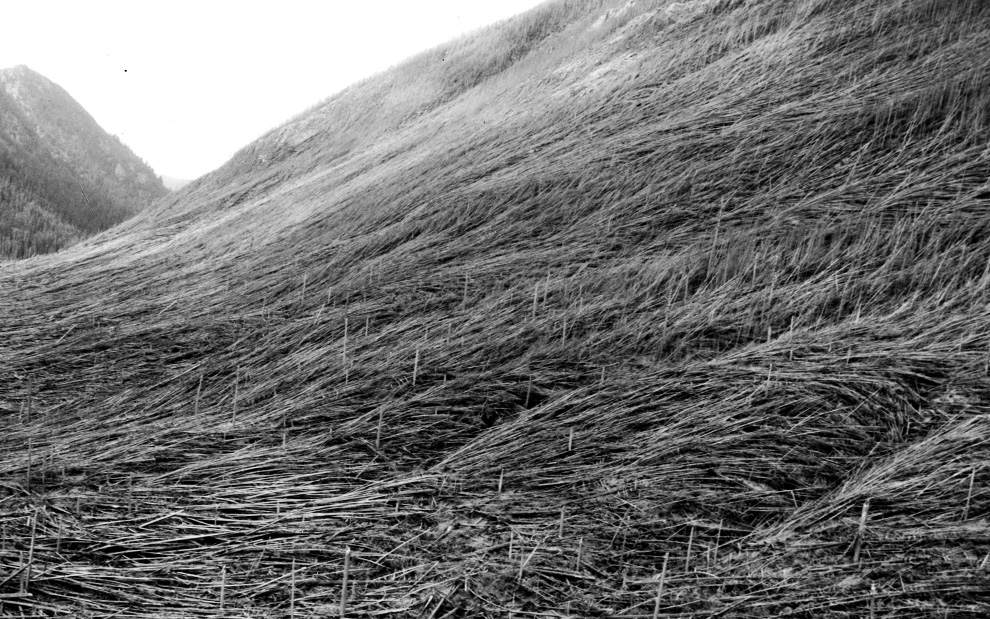 Demolition due to the massive eruption of Mt St Helens avalanche. (USGS / J. DeVine / via Big Picture )
  forests demolished by the explosion side of Mount St. Helens. Note from the disposal of fallen trees, such as air flow followed the contour of the terrain and as the trees protected against the rocky summit are still standing. Taken 22/8/1980 near North Fork Toutle River. (USGS / Lyn Topinka / via Big Picture)
  Thousands of downed trees in the watershed of North Fork Toutle River (AP Photo / USGS, Lyn Topinka / via Big Picture)
 The dense forest before the eruption consisted of over 1,200 m altitude taper underwent little of Abies amabilis and Tsuga mertensiana with diameters in the range of 75-150 cm and heights that exceeded 40 m and reached 70. The lower areas receive increased timber harvesting intervention consisted of dense stands of Pseudotsuga menziesii or Tsuga heterophylla.
 The demolition caused by the huge blow hot air fully affected nearly 40,000 hectares.
 In the margins of this area there were another 12,000 hectares where air force was not enough to bring down the trees but for burning the trees with a huge flow of air at temperatures between 100 and 350 º C.
addition another 95,000 acres were covered with ash and tephra in some places was as high a meter thick. In most of these areas at least all the seedlings died within 5 years.
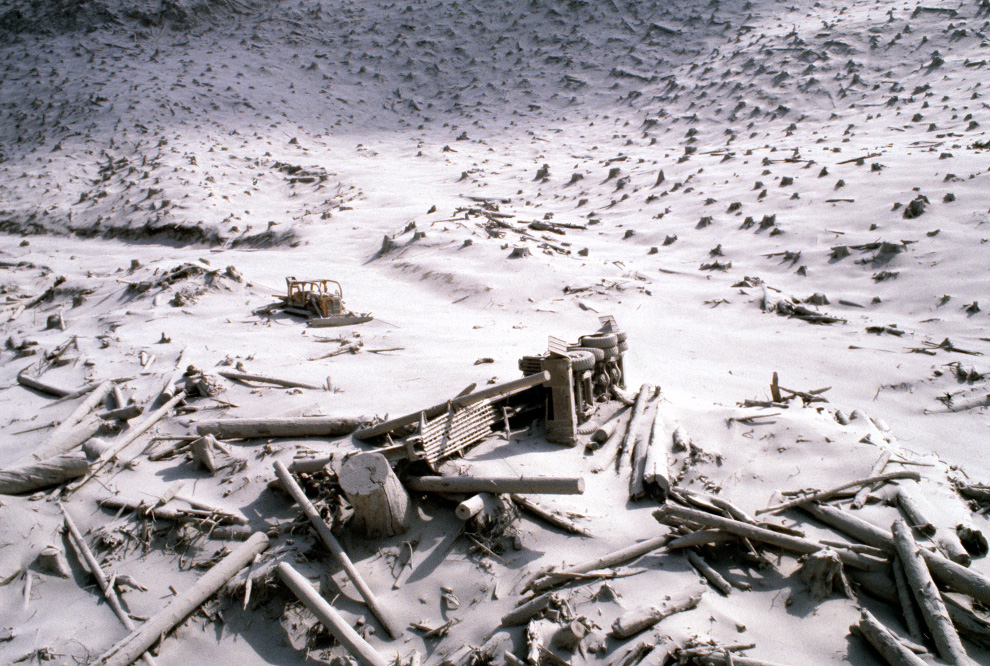
One sector of the economy most affected was that of timber harvesting. Weyerhaeuser Company Solo lost more than 24,000 hectares of its forest estate. The wood that the company had to cut and get up November 1982 would have been enough to build 85,000 three-bedroom houses. In addition, logging camps, landings, machinery and buildings were razed.
 Truck and skidder timber covered by the ashes in a forest camp Weyerhauser. (USGS / J. DeVine / via Big Picture )
is estimated that the 57 killed at least 10 officers were employed in forestry. The disgrace would have been much higher if the eruption had taken place a few hours later as due to the lifting of the exclusion areas were expected to dozens of forestry workers resumed their work.
More than 18 million trees were planted on almost 20,000 acres and another 10,000 were planted various mixtures of grasses and legumes, with little success. The experience was showing that the survival of new plants increased dramatically if the plant were removed and divided the ashes and roots were located directly above the original soil.
In 1982, Congress declared the area around the volcano as Mount St. Helens National Volcanic Monument. An area of \u200b\u200babout 44,500 hectares has been preserved entirely to go to recover without human intervention.

Referencias:
 Truck and skidder timber covered by the ashes in a forest camp Weyerhauser. (USGS / J. DeVine / via Big Picture )
 is estimated that the 57 killed at least 10 officers were employed in forestry. The disgrace would have been much higher if the eruption had taken place a few hours later as due to the lifting of the exclusion areas were expected to dozens of forestry workers resumed their work.
More than 18 million trees were planted on almost 20,000 acres and another 10,000 were planted various mixtures of grasses and legumes, with little success. The experience was showing that the survival of new plants increased dramatically if the plant were removed and divided the ashes and roots were located directly above the original soil.
In 1982, Congress declared the area around the volcano as Mount St. Helens National Volcanic Monument. An area of \u200b\u200babout 44,500 hectares has been preserved entirely to go to recover without human intervention.
Referencias:
- Mount St. Helens, 30 years ago - Boston.com - The Big Picture.
- Ecosystem Responses to the Eruption of Mt St Helens - Franklin et. al - National Geographic Research - 1985
- The many faces of Mt St Helens. A native Washingtonian's look at the reawakening of Mount St. Helens


0 comments:
Post a Comment